Rowland Harold Peake (1888-1945)
Service at Gallipoli in the 10th Light Horse
The inspiration for this page was the Sixth Remembrance Ceremony of the Charge of the Nek which was held on Sunday 08 August 2010 at Parkerville Children & Youth Care Centre, in the hills to the east of Perth. This highly successful function (this time conducted some 95 years after the battle at Gallipoli on 07 August 1915) consisted of a chapel service, a display of 10th Light Horse memorabilia and an afternoon tea. The event was organized by Phil Sullivan and attended by about 40 descendants and friends of soldiers who served in the 10th Light Horse, together with others who had connections with the Parkerville school.
Introduction
Rowland Harold Peake was born in Northam on 31 August 1888, the fifth child and first-born living son of John and Jane Peake. At the age of nineteen he married Jane Everson Marr and they had three daughters, Daphne Everson Peake, Dorothy Mona Bertha Peake and “Bonny” Edith May Peake.
He enlisted from his hometown of Northam on 23 October 1914 and was among the first of the men from Northam to enlist. He trained at Blackboy Hill and departed on 8 February 1915. In Gallipoli he was wounded in action on 07 August 1915 and following following hospitalisation in Egypt he returned to Australia on 04 November 1915. As a result of his gunshot wounds one of his legs was amputated.
Two of Rowland Peake’s brothers, Douglas John Peake and Jack Innes Peake, also enlisted for service in the 1914-18 War.
Rowland Harold Peake - Record of Service
Photograph of
Rowland Harold PEAKE
(1888-1945)
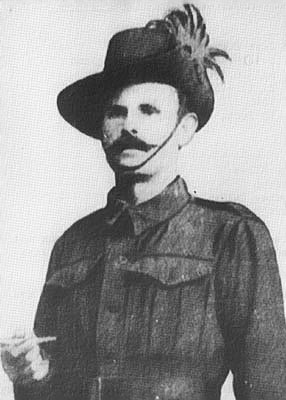
Private Rowland Harold PEAKE
10th Light Horse (Wounded).
From
“The Roll of Honour – Gallipoli Heroes”
Published in “Western Mail”
22 October 22, 1915, p.23.
(Photo taken about 1914-15)
A Daughter’s Memories
The publication “The Family of John E. and Jane Peake”, compiled by Harold D.J. Peake (first edition launched on 23 March 1986), contains on page 51 a letter written by Rowland Peake’s eldest daughter, Daphne. The accuracy of some of her memories has not been verified, but it is nevertheless an interesting account of Rowland Peake’s home-coming after his Gallipoli service.
“Members of the 10th Light Horse had to provide their own horses, I believe these were shipped from Fremantle while the enlisted men sailed from Albany. My father’s horse was a much-loved animal named “Bill”. As you know, my father was among the first to volunteer from Northam and trained at Blackboy Hill, his number was “77” and he sailed with the first contingent from Albany, as I have been informed, on the 8 February 1915.
I think that Dad was the first of Northam’s wounded men to return from the war, mother told us he was welcomed, as the hero he undoubtedly was, by the townspeople. His wound, which was responsible for the leg amputation, was received in the battle in which I think Hugo Throssel also fought and received the Victoria Cross (Rowland wounded 7 August 1915).
The Northam townfolk offered my parents a “soldiers home” for life, but in a caretaker capacity as the public were to be escorted over it on certain occasions. My mother refused this house saying that she preferred privacy in her home.
After leaving Northam, we lived in Fremantle where my father was made a recruiting officer – though very young, I vividly recall accompanying him while he addressed meetings in the open air.”
Descriptions of the "Battle of the Nek"
The published accounts of the Battle of the Nek are a synthesis of official army records and the personal observations, descriptions and memories of those who participated in the battle. It is no surprise therefore that the recollections of individual soldiers, such as Rowland Peake and the other survivors of the Battle of the Nek, may differ, reflecting the scope and diversity of their individual experiences. Nevertheless, the descriptions remain as valid statements made by those who actually experienced the horrific event.
In particular, it is often difficult to distinguish between a description of an event in which the individual actually participated and the events that took place as part of the overall military operation (similar to a player in an AFL team stating "in the last quarter we kicked six goals to their paltry two and won; the speaker could well have been a defender who kicked no goals at all to achieve the winning score). As an example, in Rowland Peake’s description of the battle (see his letter below) he states “We then scrambled out of our trenches and made for the Turkish trenches”. It is unclear whether this is simply a general statement of an activity that occurred during the overall battle or whether he had any involvement at all. In particular, his use of we, us and our (rather than I) suggests the former, consistent with the description of the battle given by Wikipedia (see extract below), which states “Colonel J.M. Antill ordered the 10th into action on the basis that he believed that the earlier waves of allied troops from the 8th had reached the Turkish trenches”.
In addition, the recollections of those who survived the battle would have been affected by the severe physical and mental stress they endured and their individual remembrances would have been clouded and/or embellished by any discussions they had with their colleagues and their officers. Indeed, it must have been a very difficult task to develop any accurate and comprehensive "official account" of what actually happened, particularly in view of the severe operational uncertainties that occurred prior to and during the battle.
The author and historian Jim Wieland recently (2008) published a book on the University Football Club (my husband Russell and his two brothers, John and Geoff Hudson, played with the club during the period from about 1957 to 1968). Jim titled the book "The Green Machine - a drinking club with a football problem". He goes to considerable lengths to state that because of the paucity of formal records of the club's history the book is, as he puts it, "an anecdotal history of the University Football Club". In other words, he interviewed past players and/or also sought written statements of their recollections of memorable events in the Club's history.
In his introduction, Jim states: "When speaking to the eminent historian Tom Stannage about the book's research method, he rather disparagingly remarked 'Well it's all bull toss then!' It is not, of course, as stories inevitably intersect and a picture emerges that can be tested and verified. This said, memory is a furtive and elusive thing, can trick and deceive, as we look back over time. Facts may be found to shift, to find different loci, and be incomplete or find different connections, but the essence of the moment could inevitably be traced."
A Published Description of the “Battle of the Nek"
The following excerpts are taken from an account published by the online encyclopedia “Wikipedia” of 8 August 2010, and describes the horrific circumstances that faced the members of the 10th Light Horse and their colleagues from other regiments.
The Battle of the Nek was a small battle fought as part of the Gallipoli campaign. "The Nek" was a narrow stretch of ridge in the Anzac battlefield on the Gallipoli peninsula. It connected the Anzac trenches on the ridge known as "Russell's Top" to the knoll called "Baby 700" on which the Turkish defenders were entrenched. In total area, the Nek is about the size of three tennis courts.
On 7 August 1915 two regiments of the Australian 3rd Light Horse Brigade mounted a tragic and futile attack on the Turkish trenches on Baby 700. The battle became known as “Godley's abattoir”.
The 3rd Light Horse Brigade, which was commanded by Colonel F.G. Hughes, comprised the 8th (Victorian), 9th (Victorian & South Australian) and 10th (Western Australian) Light Horse Regiments. Like the other Australian Light Horse and the New Zealand Mounted Rifles regiments, they had been dispatched to Gallipoli in May as infantry reinforcements, leaving their horses in Egypt.
For the three months since the 25 April landings, the Anzac beachhead had been a stalemate. In August an offensive was intended to break the deadlock by capturing the high ground of the Sari Bair range, and linking the Anzac front with a new landing to the north at Suvla. In addition to the main advance north out of the Anzac perimeter, a number of supporting attacks were planned from the existing trench positions.
The attack at the Nek was meant to coincide with an attack by New Zealand troops from Chunuk Bair, which was to be captured during the night. The light horsemen were to attack across the Nek to Baby 700 while the New Zealanders descended from the rear onto Battleship Hill, the next knoll above Baby 700.
The attack was scheduled to commence at 4:30 am on 7 August. It was to be preceded by a naval bombardment. The 8th and 10th Light Horse regiments were to advance on a front 80 metres wide in a total of four waves of 150 men each, two waves per regiment. Each wave would advance two minutes apart. The distance they would have to travel to reach the Turkish line was a mere 27 metres. Coloured marker flags were carried, to be shown from the captured trenches to indicate success.
On the morning of the 7th, it was clear that the prerequisites for the attack had not been met. The plan drafted by Colonel Skeen required a simultaneous attack from the rear of Baby 700, thereby creating a hammer and anvil effect on the Turkish trenches caught in between this pincer movement. Because the New Zealand advance was held up, and failed to reach Chunuk Bair until the morning of 8 August, a day late, the reason for charging at the Nek evaporated.
A further part of the Skeen plan required an attack from Steele's Post against German Officers' Trench by the 6th Battalion, 2nd Infantry Brigade of the Australian 1st Division, which failed. The Turkish machine guns sited there enfiladed the ground in front of Quinn's Post and the Nek. The Turkish machine gunners did not suffer any casualties as a result. Nonetheless, Major General Sir Alexander Godley, commander of the New Zealand and Australian Division of which the 3rd Light Horse Brigade was then a part, declared that the attack was to proceed.
Owing to a failure of timing instructions, the artillery preparation ceased at 4.23am while the attack was not launched until 4.30am. After the artillery firing ceased, no one knew if the bombardment was to continue. It was later discovered that the synchronisation of watches between the artillery officer and the assault officer was overlooked. As a result, the attack was not launched at the scheduled time, giving the Turkish defenders ample time to return to their trenches and prepare for the assault that they now knew was coming.
The first wave of 150 men from the 8th Light Horse Regiment, led by their commander, Lieutenant Colonel A.H. White, "hopped the bags" and went over the top. They were met with a hail of machine gun and rifle fire and within 30 seconds, Colonel White and all of his men were gunned down. A few men reached the Turkish trenches, and marker flags were reportedly seen flying, but they were quickly overwhelmed and shot or bayoneted by the Turkish defenders.
The second wave of 150 followed the first without question two minutes later and met the same fate with almost all the men cut down by heavy rifle and machine gun fire before they got half way to the Turkish trench. This was the ultimate tragedy of the Nek, that the attack was not halted after the first wave when it was clear that it was futile
Lieutenant Colonel N.M. Brazier, commander of the 10th Light Horse Regiment, attempted to have the third wave cancelled, claiming that "the whole thing was nothing but bloody murder". He was unable to find Colonel Hughes and unable to persuade the Brigade Major, Colonel J.M. Antill, who believed the reports that marker flags had been sighted. and issued the order for the third wave to proceed.
The third wave "hopped the bags" and the assault came to a quick end as before. On this assault, many men launched themselves out of the trenches and tried to dive for cover, having performed their duty to attack, but having no ambition to commit mindless suicide by attacking clearly impenetrable defenses. This explains the lower casualty rate for the 10th Light Horse Regiment. Finally, Hughes called off the attack, but confusion in the right area of the fire trench, due to an officer not being told of the cancellation, led to around 75 to 80 men of the fourth wave going over, and they too were cut down in less than a minute. By 4:45 am, the ridge was covered with fresh dead and wounded Australian soldiers, most of which remained where they fell for the duration of the campaign.
The Australian casualties from the 3rd Light Horse Brigade numbered 372; 234 from the 8th Light Horse Regiment, of which 154 were killed, and 138 from the 10th, of which 80 were killed (including L.B). The Turkish losses were negligible on this occasion for the Australians charged with unloaded rifles with fixed bayonets and were unable to return fire at all, although there are at least eight known Turkish dead.
When Commonwealth burial parties returned to the peninsula in 1919 after the war's end, the bones of the dead light horsemen were still lying thickly on the small piece of ground. The Nek Cemetery now covers most of no-man's land of the tiny battlefield, and contains the remains of 316 Australian soldiers, most of whom fell during the August 7 attack, of whom only five could be identified.
Trooper Harold Rush of the 10th Light Horse Regiment died in the third wave. His body was one of the few identified and he is buried in Walker's Ridge Cemetery. His epitaph famously reads "His last words, Goodbye Cobber, God bless you".
Rowland Peake’s Letters Home
Rowland Peake suffered wounds to both his legs during his first and only engagement with the enemy troops at Gallipoli on 7 August 1915 The following two letters were written to his wife in Northam and they provide a vivid account of his impressions of the action he had played a part in.
The letters were later published by the “Northam Advertiser”on 29 September 1915 with the following leader “A Letter from the 10th Light Horse” - Private Rowly Peake, who was wounded at Gallipoli on August 7th when the Light Horse suffered so severely, in writing to his wife, stated”:
"I am getting on as well as can be expected. The doctors have every hope of saving my leg, and the doctor who is looking after me is a London specialist in fractures, so I have every faith in him. The Turks were not satisfied in putting one bullet through my leg, they thought they would make a job of me, so gave me two shots through my right leg, and one through my left, but the latter is nothing, as the bullet went clean through and touched no bones, but I have suffered the tortures of Hell with my poor old right. It will keep me quiet for many a long day. As soon as it is fit to travel I am being sent home to Australia; if I have any luck, I expect in about a month's time I will be on the hospital ship for home. I can go to England first if I wish, but I have had enough. I have done my best for my country, and now that I am no more use for military duties, I want to go home.
It was in a bayonet charge I got hit. It was on Saturday morning, the 7th August. We got the order at 3-o'clock in the morning to "Stand to Arms." We were then marched up the firing line and told to fix bayonets and wait the order to charge. Hour after hour we waited for that order, and at last just as the sun was rising, we got the order. We then scrambled out of our trenches and made for the Turkish trenches. They met us with a terrible hail of bullets from rifles, machine guns, shrapnel and bombs; our men fell like hailstones everywhere. We gained the first Turkish trench and bayoneted them right and left until they fled like mad devils, but we followed them up and gained their second line; out of that we bayoneted them, and started for their third line. I was just on the edge of the trench when first I got one in my left leg and then two in my right, which dropped me to the ground. I rose up and made off back for our own trenches, running on the stump of my broken leg, but I could not keep going as it was too painful. I came across six of my mates, who were wounded, lying behind a little mound. I lay down with them, and for hour after hour we remained there in agony, with the bullets coming very close to us, at last one of our small party got a stray bullet in the head which put him out of his misery. A few minutes afterwards another of our party lifted his head to see how things were going and he was shot dead also. So you may guess the rest of us who were left remained very quiet.
After many hours two of our party started to crawl to our trenches, they got there safely and got some of our fellows to work to dig a trench out to us. They dug out to us all right, but I could not move so my mates linked their hands together and dragged me into safety; it was horrible being dragged across the rough ground, but it was my only chance. I saw dozens of our fellows lying dead on the field. I don't know how ever I escaped; men were being shot dead along side of me. Yet I was not killed. Well, when the 10th Regiment’s casualty list is published you will find we have been cut up alright, but we did what was asked of us! They wanted us to capture the Turkish trenches, and we did it alright, but at what cost the casualty list will tell."
In another letter, of later date, Private Peake writes:
"I have not seen any members of my regiment since I have been here, so I do not know the extent of our losses, but I know of about a dozen of my own troop who were killed. The two mates of mine whose photos I sent you were both wounded alongside of me; one of them assisted greatly to drag me back to our own trenches after I was wounded. It was the roughest passage I have ever had in my life that journey back to safety over rocks and holes. Those faithful comrades dragged me with my old leg pointing sometimes north and sometimes south, whenever it would come in contact with uneven ground, and all the while my begging them to leave me in my misery, but they would not hear of it although wounded themselves. They said 'we are going to stick to you laddie, those black devils won't get you, so come along', and away they would tug and pull me on the journey back, all the while the bullets and shrapnel were dropping around us, in fact a lump of shrapnel tore the shoulder out of my coat and shirt but by some miracle did not hurt me in the least. When we started on our journey back to our own trenches there were seven of us but only five finished the journey - three were killed getting there".
“My Comrades” – A poem by Rowland Peake.
Rowland Harold Peake wrote a number of poems during his lifetime. Copies of some of the poems are reproduced in the book on the Peake family compiled by Harold D.J. Peake (see above), and include the titles: “To My Daughter”, “My Comrades”, “The End of his Days” and “The Haunted Well”.
His poem “My Comrades” recalls those brave soldiers who left Australia with him to fight in Gallipoli and who did not return home to their loved ones.
My Comrades
Rowland H. Peake
Where are they now? Those comrades whom I knew and
learned to love, as I shall love no more.
Where Aegean’s waves of crimson-mottled blue shall
never cleanse that blood-bespattered shore.
Gallipoli, where the lonely lone-pine stands and
Neptune guards the fated Triumph’s prow
There, ‘neath the cliffs upon the myriad sands, I
saw them fall; Where are they now?
My Comrades
Think you they tarry where bright Janus shines, or
is it with dead Morpheus amid the gleaming stars?
Perchance you know they wait me where lost Pluto whines, or
are you sure they dwell with peaceful Mars?
Nay! Nay! Not there, but where-so-ever be the throne of God,
beyond that Golden Stair,
They sup with Christ who also bled on Calvary; that
we may live, they linger there.
My Comrades